
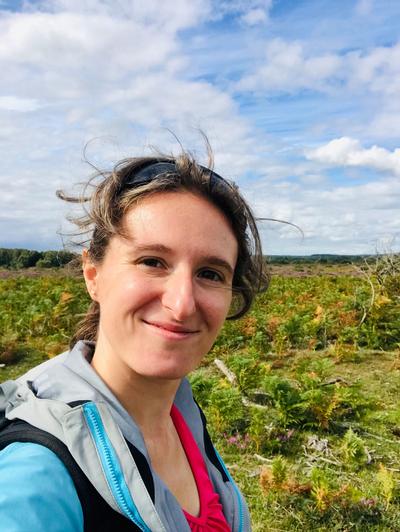
Contact details
- Name:
- Dr Sara Miglietti
- Qualifications:
- PhD Philosophy 2012 (Scuola Normale Superiore, Pisa & Université Paris 5-Descartes); PhD Renaissance Studies 2016 (University of Warwick)
- Position:
- Senior Lecturer in Cultural and Intellectual History
- Institute:
- Warburg Institute
- Location:
- Woburn Square WC1H 0AB London
- Email address:
- Sara.Miglietti@sas.ac.uk
Research Summary and Profile
- Research interests:
- Classics, Early Modern, History, History of the book, Language and Literature (French), Language and Literature (Italian), Manuscript studies, Philosophy
- Research keywords:
- Intellectual History, Renaissance Studies, Translation Studies, Book History, History of Political Thought, Environmental Humanitiies, History of Philosophy, Print Culture, Classical Reception
- Regions:
- Europe
- Summary of research interests and expertise:
-
My primary areas of expertise are the history of political thought (ancient to modern) and the intellectual history of Renaissance and early modern Europe. I am especially interested in processes of transmission, reception, and reuse of texts and ideas across geographical and chronological boundaries. Much of my work seeks to situate early modern thought in the longue durée, by reconstructing its debts to ancient and medieval traditions and its legacy on modern and contemporary culture. My research is also strongly transnational and looks at the circulation, reappropriation, and transformation of knowledge at the intersection of multiple disciplines, including intellectual history, book history, translation and reception studies, and textual editing. Additionally, I have a strong interest in historical methodology, which is is reflected both in several of my publications and in my postgraduate teaching at the Warburg Institute ("Methods and Techniques of Scholarship" module).
To date, my research has focused on three main areas:
1) the history of political thought, with a special focus on the "reason of state" tradition, Machiavellianism and anti-Machiavellianism, and political discourse during the French Wars of Religion of the sixteenth century. My work in this field is guided by the conviction that studying “politics” in the early modern period requires us to attend to the peculiar place occupied by political thought within the architectonics of early modern knowledge, paying close attention to its vital ties to other discursive fields, including ethics, rhetoric, and religion, as well as anthropology, epistemology, and cosmology. Equally central to my approach is sustained attention to the material conditions governing the circulation of political discourse, including close study of its fluid vocabulary as it developed through transnational exchange, (mis)translation, and (mis)appropriation in the deeply multilingual context of early modern Europe. Many of my publications in this area have centred around Jean Bodin (1529-1596), the French polymath who made an especially important contribution to the discourse on sovereignty in the sixteenth century. In addition to writing on various aspects of Bodin's oeuvre, I have also edited two of his most important works: Methodus ad facilem historiarum cognitionem (a treatise on historical method, of which I gave the first genetic edition in 2013); and République / De Republica (his self-translated magnum opus in six books, the last two of which I edited with the late Mario Turchetti, forthcoming with Garnier). In recognition of my leading expertise in this field, I have recently been asked to write a new entry on Bodin for the Stanford Encyclopedia of Philosophy, to replace and update the existing one by Turchetti.
2) A second core area of interest is the history of environmental ideas and practices, once again approached through a longue durée approach but with a special focus on the transformative juncture represented by the early modern period (c. 1500 to 1750). My main contribution to this field is my forthcoming monograph The Power of Place (under contract with Johns Hopkins University Press), which explores how a wide range of early modern thinkers and actors negotiated deep-rooted beliefs in the formative influence of air, terrain, and climate on human bodies and characters with equally strong commitments to free will and human agency. Intended as a contribution to ongoing debates on the history and legacy of "environmental determinisms", the book offers a counter-history of these intellectual trends that foregrounds malleability and possibilism, rather than necessity and determinism, as key themes in the relationship between humans and their environments. Other major publications in this area include Governing the Environment in the Early Modern World: Theory and Practice (with John Morgan, 2017; 2nd paperback edition, 2018); Climates Past and Present: Perspectives from Early Modern France (special issue of MLN, 2017); Climate in the Middle Ages: Between Determinism and Science (special issue of Early Science and Medicine, 2025, co-edited with Martin Lenz and Evelina Miteva; and a wide range of peer-reviewed articles, book chapters, and encyclopedia entries.
3) The history of translation, self-translation, and multilingualism, with special attention to the early modern period as a time in which relationships between classical languages (Latin, Greek, Hebrew) and modern developing vernaculars were being debated and fundamentally redefined. My work in this area has been supported by the Leverhulme Trust through a Research Project Grant for "Writing Bilinguallly, 1465-1700", on which I served as Principal Investigator from January 2023 to March 2026. In addition to several peer-reviewed articles and book chapters, this project yielded an online database and two major publications forthcoming for Brill in open-access format: a two-volume catalogue of prose self-translations produced in early modern Italy and France and an accompanying sourcebook, both co-written with postdoctoral research assistant Marco Spreafico. Building on this work, I am currently in the early stages of writing a book (under contract with Routledge) that will constitute the first monographic study of self-translation in Renaissance France. Covering major authors such as John Calvin, Jean Bodin, and René Descartes as well as a rich gallery of "minor" figures -- humanists and historians, laywers and theologians, philosophers and physicians, astrologers and travel writers -- the book will demonstrate the pervasiveness of self-translation across all kinds of prose writing, highlighting its crucial role in producing and disseminating knowledge in early modern Europe. It will also emphasize the strongly collaborative dimension of self-translation, which -- in stark contrast with common understandings of the self-translator as a lone genius -- was often learned and practiced in communal contexts (e.g. the household, the workshop, the university, the academy, the court). I envisage translation and multilingualism to remain my principal research area in the next 5-10 years. Recently, I was awarded a British Academy / Leverhulme Small Research Grant for a new project on "The Many Lives of a Book: Multilingual and Visual Transformations of Comenius’ Orbis sensualium pictus, 1658-1758", on which I will serve as Principal Investigator from January 2027 to January 2029. This pilot project is intended as a first step towards a larger project on multilingual books in early modern Europe.
- Languages:
-
Spoken Written French Fluent Fluent German - Intermediate Italian Fluent Fluent Latin - Fluent Other: Classical Greek, Spanish, Portuguese - Intermediate reading knowledge Dutch - basic reading knowledge
- Publication Details
-
Related publications/articles:
Date Details 25-Nov-2025 Humankind and the Natural World Chapters
In: Early Modern Bodies
13-Jun-2025 Mario Turchetti et la République bilingue de Jean Bodin Articles
In: Réforme, Humanisme, Renaissance
01-Jan-2025 Made into Latin by the author”: some reflections on directionality in early modern prose self-translations Chapters
In: In die falsche Richtung? Studien zu neuzeitlichen Übersetzungen ins Lateinische
18-Dec-2024 Climate after the Middle Ages: a Look at Later Developments Articles
In: Early Science and Medicine
04-Jun-2024 Researching Early Modern Self-Translation: An Interview with the “Writing Bilingually” Project Team Research aids
In: Mnemosyne: The Warburg Institute Blog
01-Apr-2024 Translations of self-translations in early modern Europe: preliminary remarks and exploratory case studies Articles
In Marie-Alice Belle & Brenda Hosington (eds), "Mediated Translation in Early Modern Europe", special issue of Philological Quarterly
01-Mar-2024 In-progress database of prose self-translations produced in Italy and France, 1465-1700 Research aids
Online database, hosted on project website: The Writing Bilingually Catalogue, 1465-1700. Self-translated books produced in early modern Italy and France
08-Jan-2024 What is an annotator? Renaissance marginalia as a textual form Chapters
In: Anthony Grafton, Nicholas Popper, William Sherman (eds), Gabriel Harvey and the History of Reading. Essays by Lisa Jardine and others (London: UCL Press, 2023)
01-Jan-2024 Flood, Fire and Tears: Imagining Climate Apocalypse in Scheuchzer’s De portione (1707/08) Chapters
In: Ovanes Akopyan and David Rosenthal (eds), Disaster in the Early Modern World Examinations, Representations, Interventions (Routledge, 2024)
28-Apr-2023 Ambiente Chapters
In: Il lessico della modernità. Continuità e cambiamenti fra ’400 e ’700, ed. Simonetta Bassi (Pisa: ETS, 2023)
21-Dec-2022 The private is political: Anna Becker on the Renaissance household’ Review
Review of Anna Becker, Gendering the Renaissance Commonwealth (Cambridge: Cambridge University Press, 2020), ISBN: 978-1-108-48705-4. Intellectual History Review (2022).
01-Aug-2022 Un caso di autotraduzione medico-scientifica nel Rinascimento: Il Pourtraict de la santé / Diaeteticon polyhistoricon di Joseph Duchesne (1606) Chapters
In: Jean-Louis Fournel and Ivano Paccagnella (eds), Traduire - tradurre - translating. Vie des mots et voies des œuvres dans l’Europe de la Renaissance (Geneva: Droz, 2022)
01-Apr-2022 Jean Bodin, une pensee en mouvement. Etude des variantes entre les deux rédactions de la Methodus (1566, 1572) Articles
In: Seizième Siècle (20)
01-Jan-2022 Climate Theories in Italy Research aids
In: The Renaissance World (Routledge Resources Online)
01-Jul-2021 Sara Miglietti, Jean Bodin’s République Chapters
In: Reading Texts on Sovereignty: Textual Moments in the History of Political Thought, ed. Stella Achilleos and Antonis Balasopoulos (London: Bloomsbury, 2021), pp. 65-72.
01-Dec-2020 Review of: Lydia Barnett, After the Flood: Imagining the Global Environment in Early Modern Europe (Baltimore, MD: Johns Hopkins University Press, 2019), ISBN: 9781421429519. Review
American Historical Review, 125/5 (2020): 1951-1952.
01-Dec-2020 Review of: Howell A. Lloyd, Jean Bodin, ‘This Pre-eminent Man of France’: An Intellectual Biography (Oxford: Oxford University Press, 2017), ISBN 978-0-19-880014-9. Review
History of Political Thought, 41/4 (2020): 676-680.
01-Jul-2020 ENVIRONMENTAL ETHICS FOR A FALLEN WORLD: JOHANN JAKOB SCHEUCHZER (1672-1733) AND THE BOUNDARIES OF HUMAN AGENCY Articles
Earth Sciences History, 39/2
24-Mar-2020 Between Nature and Culture: The Integrated Ecology of Renaissance Climate Theories Chapters
In: Pauline Goul and Philip Usher (eds), Early Modern Ecologies: Beyond English Ecocriticism (Amsterdam University Press)
01-Jan-2020 Jean Bodin on Action and Contemplation: A Reappraisal Chapters
In: Penser et agir à la Renaissance / Thought and Action in the Renaissance, eds. Philippe Desan and Véronique Ferrer (Droz)
31-Dec-2019 Climate theory: an invented tradition? Chapters
Spreading Knowledge in a Changing World, ed. Charles Burnett and Pedro Mantas-España (UCO Press)
01-Apr-2019 En langage latin et francoys communiqué: Antoine Mizauld's Astro-Meteorological Self-Translations Articles
Rivista di Storia della Filosofia, 2/2019
01-Dec-2017 Sara Miglietti (ed.), Climates Past and Present: Perspectives from Early Modern France Edited Book
Special issue of Modern Language Notes
01-Jan-2017 Sara Miglietti and John Morgan (eds), Governing the Environment in the Early Modern World: Theory and Practice Edited Book
Routledge, Environmental Humanities Series
01-Jul-2016 Sara Miglietti and Sarah Parker (eds), Reading Publics in Renaissance Europe, 1450-1650 Edited Book
Special issue of History of European Ideas
01-Jul-2016 Sara Miglietti, Wholesome or Pestilential? Giovanni Battista Doni (1594-1647) and the Dispute on Roman Air Articles
In: The Renaissance Dialogue, ed. Roberta Ricci and Simona Wright. Special issue of NeMLA Italian Studies 38 (2016): 203-220.
01-Jul-2016 Sara Miglietti, The Censor as Reader: Censorial Responses to Bodin’s Methodus in Counter-Reformation Italy (1587-1607) Articles
In: Reading Publics in Renaissance Europe, 1450-1650, ed. Sara Miglietti and Sarah Parker. Special issue of History of European Ideas 45/2 (2016): 707-721
01-Jul-2015 Sara Miglietti, Methodus ad facilem historiarum cognitionem; Bodin, Jean Chapters
IN: Christian-Muslim Relations: A Bibliographical History. Vol. 6: Western Europe (1500-1600), ed. David Thomas & al. (Leiden: Brill, 2015), 778-787 and 775-778.
01-Jul-2014 Sara Miglietti, Al di là dell’“auteur d’un seul livre”: Cesare Vasoli lettore di Jean Bodin Articles
In: Rinascimento 54 (2014): 133-146.
01-Jul-2014 Sara Miglietti, Meaning in a Changing Context: Towards an Interdisciplinary Approach to Authorial Revision Articles
In: History of European Ideas 40/4 (2014): 474-494.
01-Jul-2013 Sara Miglietti, Le souverain remède. Letture machiavelliane della crisi in Francia (1573-1579) Articles
IN: Rinascimento 53 (2013): 73-110.
01-Jul-2013 Sara Miglietti, Reading from the Margins: Some Insights into the Early Reception of Bodin’s Methodus Chapters
In: The Reception of Bodin, ed. Howell A. Lloyd (Leiden: Brill, 2013), 193-217.
01-Jul-2013 Jean Bodin, Methodus ad facilem historiarum cognitionem. Text, translation, genetic apparatus, and commentary by Sara Miglietti Monographs
Pisa, Edizioni della Normale
Publications available on SAS-space:
Date Details Feb-2019 "En langage latin et françoys communiqué": Antoine Mizauld's Astrometeorological Self-Translations PeerReviewed
This article explores the phenomenon of philosophical and scientific self-translation in sixteenth-century France, focusing on the «astrophile» physician Antoine Mizauld (c. 1512-1578) who, in the 1540s and 1550s, translated several of his own astrometeorological works from French into Latin. By paying as much attention to the textual and paratextual features of Mizauld’s self-translations as to Mizauld’s cultural milieus, marketing strategies, and possible goals in self-translating, the article aims at studying Renaissance self-translation not only as a literary practice but also as a social practice of cultural mediation, shaped by contextual pressures such as book market dynamics, changing reading publics, and the political implications of language use in a time of nation-building.
Jan-2018 Sovereignty, Territory, and Population in Jean Bodin's "République" PeerReviewed
This article offers a re-interpretation of Jean Bodin’s Six livres de la République (1576), a work that deeply transformed European political discourse at the time of the French Wars of Religion and that had important repercussions on the later ‘reason of state’ tradition. Highlighting the ties between Bodin’s definition of sovereignty in Book 1 and his discussion of demographic growth and territorial expansion in Books 4, 5, and 6, the article shows that Bodin’s critical contribution to early modern political thought, far from being limited to his reframing of the juristic concept of souveraineté or maiestas, extends to his novel understanding of the territory as a non-juridical ‘technologie politique’ (Michel Foucault). Through an examination of Bodin’s work and its later reception, the article argues that Bodin’s insights about territorial and demographic matters played a fundamental role in the early modern ‘territorialisation de la politique’ (Romain Descendre), in that they helped redefine the very terms in which the notion of territory would be understood and discussed in the following decades.
Mar-2015 An Eighteenth-Century Thought Experiment on Climate Change: Johann Jakob Scheuchzer's "De ignis seu caloris certa portione Heluetiae adsignata" (1708) PeerReviewed
Johann Jakob Scheuchzer’s De ignis seu caloris certa portione Heluetiae adsignata (1708) is one of a series of scientific papers that the prominent Swiss physician and naturalist (1672-1733) sent to the Royal Society in the early 1700s. This particular essay provides an original contribution to physico-theological thought. Unlike most natural-theological works, it emphasises the dangers of human intervention in nature. As an early modern thought-experiment on climate warming and its expected consequences on Alpine and European ecosystems, it seems to anticipate modern anxiety over climate change. But it is also a fine piece of Neo-Latin mountain-writing in the tradition of earlier authors such as Henricus Glareanus (1488-1563) and Conrad Gesner (1516-1565). This article offers the first edition of De ignis seu caloris certa portione, based on Scheuchzer’s autograph in the Royal Society collections in London. Scheuchzer’s text is accompanied by an English translation, a full textual commentary, a short biography of the author, and an appendix providing the details of Scheuchzer’s papers and letters to the Royal Society for 1703-1708.
Aug-2010 Amitié, harmonie et paix politique chez Aristote et Jean Bodin PeerReviewed
La crise politique et religieuse de la seconde moitié du xvie siècle ouvre la voie en France à un débat enflammé concernant les limites du pouvoir souverain et le rôle du peuple au sein de l’État. Dans les Six livres de la République (1576), Jean Bodin développe un programme de réforme éthico-politique envisageant l’amitié entre les citoyens comme pierre angulaire de l’État. Bien que s’inspirant largement des réflexions d’Aristote sur le même sujet (Éthique à Nicomaque, Politique), il remplace toutefois la théorie aristotélicienne de l’amitié-égalité (laquelle entraîne chez le Stagirite une vision égalitariste de la société et un net refus de la monarchie) par une nouvelle théorie de l’amitié-harmonie qui lui permet de justifier la nature hiérarchique et monarchique de sa « République bien ordonnée ».
Jun-2010 "Justice et liberté". Des volontaires italiens en Catalogne (1936-1937) PeerReviewed
Analyse de l'expérience des volontaires italiens de "Giustizia e Libertà" dans la Guerre Civile d'Espagne à travers leurs reportages de guerre, carnets personnels et lettres privées, pour faire ressortir le caractère existentiel et philosophique de leur militantisme
Jan-2016 Debating Greatness from Machiavelli to Burton PeerReviewed
From early humanist treatises on city government in Italy to Rousseau’s "Social Contract", “greatness” (grandezza, grandeza, grandeur) was often presented as both the aim that political communities should pursue and the touchstone to measure their relative success. But what exactly should be understood by “greatness”, and how could it be achieved? Although most authors agreed that it took more than a large territory for a state to be truly “great”, they all seemed to prioritise different things: political liberty, military strength, material wealth, absence of strife, a solid social and political order, or the happiness and overall wellbeing of the citizens. In an age of state- and empire-building, the debate on the nature of political “greatness” raised critical questions and contributed to shaping the agenda and the self-representation of European powers. By concentrating on a few selected thinkers (Machiavelli, Bodin, Botero, Bacon, Burton) whose works form a complex network of mutual influences, this chapter seeks to investigate an exemplary case of unceasing dialogue between the Renaissance and the early modern period.
May-2019 New Worlds, Ancient Theories: Reshaping Climate Theory in the Early Colonial Atlantic PeerReviewed
Jan-2020 Climate Theory: An Invented Tradition? PeerReviewed
The article responds to recent claims that the term ‘climate’ was never used in a physical or meteorological sense until the mid-eighteenth century, and that consequently the notion of 'climate theory' (often used to denote doctrines of environmental influence from Antiquity to the Enlightenment) is an anachronistic scholarly construct to be avoided at all costs. The article discusses a number of ancient and early modern examples to show that the pre-modern meaning of ‘climate’ (in its various linguistic forms) was richer than is sometimes assumed, and that a physical and/or meteorological usage of the term was in fact not completely alien to pre- modern writers. The article also raises broader methodological questions, asking whether it may be legitimate to use ‘etic’ (observer-oriented) rather than ‘emic’ (actor-oriented) categories to study the history of climate ideas.
Mar-2020 Jean Bodin on Action and Contemplation: A Reappraisal PeerReviewed
This essay offers a new interpretation of Bodin’s stance on the classic issue of action and contemplation -- a vexata quaestio of Bodinian scholarship that takes us to the heart of Bodin's views on ethics, politics, and theology. Taking into account the entire arc of Bodin's production, from the Methodus to the Paradoxon, the article considers Bodin's changing views on the 'best form of life' and argues that towards the end of his life Bodin came to redefine completely the problem by positing a third stage of human experience, which he called "reflection" (actus reflexus in Latin, reflexion in French) and described as the passive enjoyment of God's light reflected in the human soul as in a mirror. The article explores how Bodin's theory of reflection relates to his theology and spirituality, on the one hand, and to his ethical views on the other. By raising the question of Bodin’s sources for this theory, the article also uncovers his profound debts to late-medieval Scholasticism and Christian mysticism, especially that of Nicholas of Cusa.
Mar-2020 Between Nature and Culture: The Integrated Ecology of Renaissance Climate Theories PeerReviewed
This essay examines French Renaissance “climate theories” as a privileged locus for rethinking the relationship between “nature” and “culture” in a dynamic and non-dualistic way (B. Latour). Climate theories, first advanced in ancient Greece by authors such as Hippocrates and Aristotle, were widely invoked in the Renaissance to explain temperamental differences among individuals as well as cultural and ethnic differences among human collectives. While scholars often bring such theories together under the umbrella term of “climatic determinism”, this article argues that Renaissance climate theories are in fact predominantly anti-deterministic, as they acknowledge the possibility for humans to shield themselves from climate’s influence in a variety of ways, including diet, music, and a liberal education. Far from postulating an absolute power of “nature” over “culture”, Renaissance climate theories draw attention to the peculiar “epistemic space” (lieu epistémique, J.-B. Fressoz) in-between nature and culture, as they seek to illuminate the mutually-constitutive interactions between the two. Thus, climate theories also shed light on the radical embeddedness of humans in nature, helping us to evisage man not as “external to nature” and standing in a relation of “domination or opposition” to it, but as deeply inscribed in natural processes (C. Larrère). Building on foundational scholarship by Bruno Latour and others, this essay proposes an analysis of some better- and lesser-known examples of French Renaissance climate theories (e.g. Louis Le Roy, Jean Bodin, Nicolas Abraham de La Framboisière) in order to reflect on what the “environmental reflexivity” of early modern societies can bring to a new “integrated ecology” of nature and human culture (J.-B. Fressoz, C. Larrère).
Jan-2017 Introduction: Ruling "Climates" in the Early Modern World NonPeerReviewed
Introduction to Sara Miglietti and John Morgan (eds). Governing the Environment in the Early Modern World: Theory and Practice. Abingdon and New York: Routledge, 2017
Jean Bodin. Methodus ad facilem historiarum cognitionem. Edizione, traduzione e commento. PeerReviewed
Mancava sia in Italia che in Francia una moderna edizione della Methodus ad facilem historiarum cognitionem che segnalasse le varianti tra le due stampe parigine del 1566 e del 1572. Questo volume presenta ora l’edizione comparata del testo corredato dall’apparato delle fonti e da un ampio commento, affiancati dalla traduzione italiana. Il lettore ha così a disposizione un’opera che, da un lato, raccoglie la tradizione critica e storiografica precedente a Bodin, dall’altro individua e comincia a sviluppare temi essenziali del pensiero e della cultura dell’Europa moderna.
Jan-2016 Botero, Giovanni PeerReviewed
Encyclopedia entry
Dec-2018 Nicodemism PeerReviewed
Encyclopedia entry
Apr-2022 Jean Bodin: une pensée en mouvement. Etude des variantes entre les deux rédactions de la Methodus (1566, 1572) PeerReviewed
Cette étude porte sur l’évolution de la théorie politique de Jean Bodin entre 1566 et 1576, une période tout à fait décisive pour le penseur angevin, notamment par rapport au développement de ses idées sur la nature et les limites de la souveraineté. C'est dans cette période que Bodin change d'avis sur certains points-clés de sa théorie politique : passage d’un concept de souveraineté comme fonction juridictionnelle à celui de souveraineté comme fonction législative ; découverte ou clarification des « marques » de perpétuité, indivisibilité et autonomie comme propres du véritable pouvoir souverain ; mise à point d’une distinction claire entre potestas (puissance publique, de nature juridico-politique) et dominium (puissance privée, de nature économique-propriétaire). L'étude comparée des deux rédactions de la Methodus (1566, 1572) par rapport à la première République (1576) montre que cette évolution se fit de manière graduelle et pour des raisons qui ont affaire à la logique interne de la pensée bodinienne tout autant, sinon plus, qu’aux circonstances historiques dans lesquelles Bodin écrivait ses œuvres.
Un Caso Di Autotraduzione Medico-Scientifica Nel Rinascimento: Il Pourtraict De La Santé / Diaeteticon Polyhistoricon Di Joseph Duchesne (1606) PeerReviewed
Medico paracelsiano alla corte di Enrico IV e prolifico autore di testi di medicina e di filosofia naturale, il calvinista Joseph Duchesne, detto anche Quercetanus (c. 1544 – 1609), è noto da tempo agli storici della medicina e della scienza per il contributo fondamentale che portò alla diffusione del paracelsismo e della nuova filosofica chimica in Francia a cavallo tra Cinque e Seicento. Molto meno noto è il suo doppio trattato di dietetica del 1606, uscito quasi simultaneamente in francese (Le Pourtraict de la santé) e in latino (Diaeteticon polyhistoricon), e rimasto ancora relativamente inesplorato dalla critica. Si tratta tuttavia di un testo di eccezionale interesse, in particolar modo per la sua natura di testo autotradotto. Il presente contributo si propone di riesaminare brevemente il «dittico» di Duchesne sotto il profilo della sua dimensione bilingue, traendo qualche conclusione preliminare sulle strategie autotraduttive di Duchesne e sui suoi possibili obiettivi.
Nov-2020 Environmental Ethics For A Fallen World: Johann Jakob Scheuchzer (1672–1733) And The Boundaries Of Human Agency PeerReviewed
This article traces the formation of a (self-)critical discourse around human environmental agency in early Enlightenment Europe, focusing on the Swiss naturalist Johann Jakob Scheuchzer (1672–1733) and the Royal Society milieus to which he was connected. In manuscript and printed writings, and particularly in his beautifully illustrated Physica sacra (1731–1735), Scheuchzer used a combination of biblical exegesis, thought experiments, and ecological insights to reflect about the relationship between God, humankind, and nature. Against claims that the tradition of natural theology in which Scheuchzer belonged “prevented and delayed the acknowledgment of the earth as vulnerable” (Kempe 2003b, p. 166), the article shows how different thinkers could use the Bible to support competing claims regarding the role of humans as agents in God’s creation. While some authors enthusiastically upheld contemporary ideologies of environmental ‘improvement’, others—including Scheuchzer himself—called for greater self-restraint and developed a biblically-grounded form of precautionary environmental ethics.
Apr-2023 Ambiente NonPeerReviewed
A study of the evolution of the term and notion of "ambiente" (Italian for environment) from classical antiquity to the 19th century, with a focus on semantic changes in the early modern period.
May-2022 Climate theories in Italy PeerReviewed
“Climate theory” is a modern umbrella term for various historical doctrines that highlighted the impact of climatic and geographical factors (e.g., temperature, winds, relief, etc.) on human bodies, minds, and behaviours. Such doctrines were often associated with ethnic stereotyping, as different regions of the earth were thought to engender distinctive “national characters”: e.g., the gluttonous German, the vengeful Italian, the fickle French. While the origins of climate theory date back to classical antiquity, with the Hippocratic school of medicine and the theory of the humors, the early modern period is often considered the heyday of this tradition. Modern surveys of climate theory generally highlight the role played by French thinkers such as Jean Bodin (1529-1596), who wrote extensively about the impact of climate on national character and about its implications for politics and law-making. Yet climate theory was not the monopoly of any one thinker or nation. On the contrary, it circulated widely throughout Europe, crisscrossing geographic and linguistic borders through the medium of print, translation, and epistolary networks of intellectual exchange. At the same time, climate theory particularly flourished in places where universities, academies, and princely courts fostered continued engagement with ancient and medieval texts steeped in that tradition. Italy in the sixteenth and seventeenth centuries was just such a place. Doctors, philosophers, theologians, and political thinkers discussed these theories from various standpoints, sometimes engaging in heated controversies. In particular, three major points of debate were the scale at which environmental influences should be studied, the relationship between environment and ethics, and the accommodation of classical ideas to Catholic doctrine and to the missionary agenda of the Counter-Reformation Church.
Jun-2026 Review of: David N. Livingstone. The Empire of Climate: A History of an Idea. Princeton University Press, 2024 NonPeerReviewed
Review of: David N. Livingstone. The Empire of Climate: A History of an Idea. Princeton University Press, 2024.
Jun-2025 Mario Turchetti et la République bilingue de Jean Bodin PeerReviewed
Posthumous reflections on Mario Turchetti's work as editor of Bodin's bilingual République (1576, 1586)
"Made into Latin by the author”: some reflections on directionality in early modern prose self-translations PeerReviewed
Drawing from the “Writing Bilingually Catalogue”, a new database currently being developed at the Warburg Institute, the essay explores how self-translations (works translated by the authors themselves) can yield a more nuanced understanding of Latin-vernacular dynamics in early modern Europe, with particular attention to France. Challenging established narratives of a longstanding pre-eminence of Latin in technical domains such as theology, philosophy, and law, the essay shows how self-translations did not always flow from Latin into French, but also from French into Latin or across both languages simultaneously, depending as much on authors’ views of language as on genre, intended audience, and contextual factors such as political events and broader cultural processes. Directionality thus emerges as a useful but problematic category that needs closer investigation in the context of early modern translation cultures.
Jan-2024 What is an Annotator? Renaissance Marginalia as a Textual Form PeerReviewed
There is an entrenched tendency, even among scholars who take marginalia quite seriously, to consider them as a somewhat subsidiary, instrumental form of activity – one that is less creative, less autonomous, overall less ‘authorial’ than so-called original writing. This essay argues instead that annotation should be understood not merely as a form of ‘active reading’ propaedeutic to future writing, but as a practice that has value on its own: it can be a form of original textual creation; a countercultural authorial gesture; in some cases, even an entire way of life. If we want to recover the wealth of meanings and functions that annotation had in the Renaissance, we need a new interpretive framework to make sense of it. This chapter will make a strong case for this need, clearing some potential roadblocks and tentatively suggesting a few avenues for future investigation.
Mar-2024 The Writing Bilingually Catalogue, 1465-1700. Self-translated books produced in early modern Italy and France NonPeerReviewed
Discover the multilingual world of early modern Europe through the Writing Bilingually Catalogue (WBC), the first large-scale repertory of self-translations produced in Italy and France from the early age of print to the end of the seventeenth century. From travel accounts and funeral orations to hefty tomes on medicine and theology, WBC brings together over 500 prose works produced in two or more language versions by early modern authors and their collaborators, enriching and transforming our understanding of multilingual authorship in the early modern period. Gathered here together for the very first time, these works provide a unique window onto a world where classical languages and modern vernaculars coexisted in fruitful symbiosis. Writers self-translated across different languages to reach wider readerships while displaying linguistic mastery and retaining control over their work. In so doing they often revised their original source-texts, whether to adapt them to a different intended public or for other reasons. From Leon Battista Alberti’s On Painting to John Calvin's Institutes of the Christian Religion, many important works from this period exist in different (but equally authorial) language versions, which are best studied together like panels of a same diptych. WBC is the outcome of a research project based at London's Warburg Institute and funded by the Leverhulme Trust (RPG-2022-221). Research started in January 2023 and ended in March 2026, eventually resulting in two main outputs: a two-volume annotated catalogue and an accompanying anthology of primary sources in translation. Both are currently under review with Brill and will be published open-access on Brill's digital platform in late 2026 or early 2027. The project also yielded a PhD thesis on self-translation and language debates (questione della lingua) in Renaissance Italy.
Translations of self-translations in early modern Europe: preliminary remarks and exploratory case studies PeerReviewed
Self-translations – works rewritten in a second language by their own authors – represent a significant subset of early modern translations. Generally taking place between Latin and a vernacular, self-translation enabled authors to expand and diversify their readership while retaining control over their message. But what happened when self-translations were translated into other languages by ‘ordinary’ translators? Was either version – the Latin or the vernacular – more commonly taken as the basis for further translations, or did translators seek to take both versions into account where possible? What can the choices made by these translators tell us about shifting language dynamics, strategies of cultural mediation, and material access to foreign language books in early modern Europe? This article will tackle these questions by focusing on Franco-Latin works translated into English according to three possible scenarios: translations based on a composite text (e.g. Knolles’s translation of Bodin's République / De republica), translations based on the Latin version (e.g. Norton’s translation of Calvin’s Institutio Christianae religionis / Institution de la religion chrestienne), and translations based on the vernacular version (e.g. Carew’s translation of Estienne’s Apologia pro Herodoto / Introduction au traité de la conformité). Overall, the article will argue that the translation of self-translations can be considered as a special case of indirect translation in which the mediating translation itself comes from the original author.
Mar-2017 Governing the Environment in the Early Modern World: Theory and Practice PeerReviewed
Throughout the early modern period, scientific debate and governmental action became increasingly preoccupied with the environment, generating discussion across Europe and the wider world as to how to improve land and climate for human benefit. This discourse eventually promoted the reconsideration of long-held beliefs about the role of climate in upholding the social order, driving economies and affecting public health. Governing the Environment in the Early Modern World explores the relationship between cultural perceptions of the environment and practical attempts at environmental regulation and change between 1500 and 1800. Taking a cultural and intellectual approach to early modern environmental governance, this edited collection combines an interpretative perspective with new insights into a period largely unfamiliar to environmental historians. Using a rich and multifaceted narrative, this book offers an understanding as to how efforts to enhance productive aspects of the environment were both led by and contributed to new conceptualisations of the role of ‘nature’ in human society.
Publications available on SAS-space
Consultancy reports:
Date Details Consultant for Mercedes Benz Future Research foundation (October 2025) - Current trends to revive to term/topic/trope "Renaissance“ for contemporary discourses
- How is the Renaissance framed historically today, how has this / its meaning/image changed in the last decades?
- What makes the Renaissance relevant for what is happening today?
- Research Projects & Supervisions
-
Research projects:
Details The Many Lives of a Book: Transformations of Comenius’ Orbis pictus, 1658-1758 Warburg Institute
Project period: 18-Jan-2027 - 17-Jan-2029Research interests: Classics, Digital resources, Early Modern, Education, History, History of art, History of the book, Language and Literature (French), Language and Literature (German), Language and Literature (Italian), Literatures in a modern language, Philosophy
Writing Bilingually, 1465–1700: Self-Translated Books in Italy and France Warburg Institute
Project period: 04-Jan-2023 - 31-Mar-2026Research interests: Classics, History of the book, Language and Literature (French), Language and Literature (Italian), Manuscript studies
Antiquity and Its Uses: Reception and Renewal A programme of meetings, mutual visits, and exchanges (including both academic staff and PhD students) around the topic ‘Antiquity and its Uses: Reception and Renewal’, between Warwick's Centre for the Study of the Renaissance and Johns Hopkins University's Charles Singleton Center for Pre-Modern History. The project ran between 2015-2017. PI: David Lines (Warwick). CIs Ingrid De Smet (Warwick), Sara Miglietti (JHU), Eugenio Refini (JHU)
The Many Lives of a Book: Multilingual and Visual Transformations of Comenius’ "Orbis sensualium pictus", 1658–1758 Jan Amos Comenius’ Orbis sensualium pictus (1658) is a pioneering multilingual illustrated children’s book which systematically combined vernacular and Latin text with images to teach language and knowledge through sensory experience. Through hundreds of editions, translations, and adaptations, the Orbis pictus quickly became a foundational text in early-modern education, influencing thinkers such as John Locke, Jean-Jacques Rousseau, and Johann Wolfgang von Goethe. Its pathways of transmission, however, remain surprisingly understudied. Focusing on the first century of its reception (1658–1758), this project examines how the Orbis pictus was reshaped through both visual and multilingual reconfiguration, and what these changes reveal about the impact and adaptation of Comenius’ pedagogical, philosophical, and theological ideas in diverse contexts.
The Power of Place This project examines the long history of 'climate theories' (i.e. theories about the power of place and climate on human character) and how these theories shaped early modern Europeans' attitudes towards nature. The results will be shared in a book under contract with Johns Hopkins University, tentatively entitled 'The Power of Place: Climates and Characters in Early Modern Thought'. Several shorter publications have already emerged from this project, as detailed under "Publications".
Writing Bilingually, 1465-1700: Self-Translated Books in Italy and France LEVERHULME PROJECT GRANT RPG-2022-221 (January 2023-March 2026), PI Sara Miglietti
Early modern Europe was a multilingual world: while Latin was still the lingua franca of international scholarly exchanges, vernacular languages were increasingly being used for both literary and scientific endeavours. Mediating between these realms were legions of translators, but also a surprisingly large number of authors who chose to translate their own works, mainly between Latin and a vernacular. This project aims to produce the first annotated catalogue of prose self-translations printed in Italy and France between 1465 and 1700, alongisde an anthology of relevant primary sources in English translation. Both the catalogue and the anthology will appear with Brill in 2026, while several shorter publications by the PI Sara Miglietti and/or postdoctoral research assistant Marco Spreafico have already appeared or are forthcoming in journals or edited volumes.
Current PhD topics supervised:
Dates Details From: 30-Sep-2024
Until:Agriculture, Mission, and Civilisation-Building in 17th-Century New France Alexander Gould, in progress
From: 29-Sep-2025
Until:“By the pricking of my thumbs” – Female Agency and the Body in Early Modern English Witchcraft. Irina Husti-Radulet, in progress
From: 04-Jan-2023
Until:Self-Translation and the Questione della Lingua in Renaissance Italy Eugenia Sisto (part of Leverhulme project Writing Bilingually 1465-1700) - in progress
From:
Until:Scientific Instruments and Clocks in a Florentine Workshop: the Della Volpaia Family Marisa Addomine - in progress
From:
Until:Pierre Gassendi and the Epicurean Anatomists, 1620-1680 Guillermo Willis (deferred start January 2021), in progress
Past PhD topics supervised:
Dates Details From:
Until:Reformations after the Reformation: Defining Protestantism and Reformed Catholicism in France, 1580-1616 Claire Konieczny (Johns Hopkins University) - successfully defended 2022
From:
Until:The Renaissance of Platonic Theurgy from Ficino to Agrippa Merlin Cox (Warburg) - successfully defended 2022
From:
Until:Convivial Humanism: Giovanni Pontano (1426-1503) on the Art of Living Together From:
Until:Women in arms: Female warriors in Italian art 1500-1700 From:
Until:The Passions of the Soul, Natural Philosophy and Medicine: Theories of Emotion in Seventeenth-Century England From:
Until:The Making of an Astrologer in Fifteenth-Century France. The Notebooks of S. Belle: Lisbon, MS 1711 and Paris, NAL 398 Available for doctoral supervision: Yes
- Professional Affiliations
-
Professional affiliations:
Name Activity International Association for Neo-Latin Studies Member Renaissance Society of America Discipline Representative for Philosophy Renaissance Society of America Member Fédération Internationale des Sociétés et Instituts pour l’Étude de la Renaissance Warburg representative Collaborations:
Name Type Activity Start date End date Rinascimento (journal) Editorial board member 2024 De Gruyter book series "Renaissance Mind: Studies on the History of Knowledge" Advisory board member 2022 Warwick Studies in Renaissance Thought and Culture (Brepols book series) Editorial board member 2021 From East to West, and Back Again: Student Travel and Transcultural Knowledge Production in Renaissance Europe (c. 1470- c. 1620) Advisory board 2020 The Archaeology of Reading Advisory board 2015 2019 - Relevant Events
-
Related events:
Date Details 01-Feb-2019 Interventions: The Intellectual History Podcast Episode on "Bodin, self-translation, and the environment in early modern Europe"
Other editing/publishing activities:
Date Details Invited peer-reviewer Oxford University Press, Johns Hopkins University Press, Routledge, Rinascimento, Perspectives on Science, History of Political Thought, Intellectual History Review, American Historical Review, Journal of the Warburg and Courtauld Institutes, Journal of the History of Ideas, Modern Language Notes, Selva, Journal of Early Modern Christianity, Acts of the International Association for Neo-Latin Studies
Invited peer-reviewer Belgian Fund for National Research, Fonds National de la Recherche Suisse, University of Strasbourg
Knowledge transfer activities:
Details ‘Renaissance self-bibliography: An unexplored (mostly Neo-Latin?) genre’. International conference ‘Old and New exempla: Strategies of Legitimization and Authorization in Neo-Latin’, University of Innsbruck, 26-27 September 2026.
Autolatinizzarsi nel Rinascimento: prospettive dal progetto "Writing Bilingually, 1465-1700" International conference ‘Latinitate donare: Progetti di ricerca sulle traduzioni in latino in età moderna’, Sapienza Università di Roma, 24 February 2026.
Presentation of the ‘Writing Bilingually’ project e-Public of Letters online seminar, 19 November 2025.
‘Writing Bilingually, 1465-1700: Self-Translated Books in Italy and France. A Leverhulme-funded project based at London’s Warburg Institute.’ Poster presentation at XIX Congress of the International Association for Neo-Latin Studies, Aix-en-Provence, 14-20 July 2025
Presentation of the ‘Writing Bilingually’ project University of Oxford, Taylorian Library, 12 June 2025.
"Collaborative self-translation" in early modern Europe Roundtable on early modern authorship, Harvard University, 24 March 2025.
‘New Resources for Studying and Teaching Renaissance Self-Translation' Annual Conference of the Renaissance Society of America, Boston, 20-22 March 2025
Building a Database of Renaissance Self-Translations ‘Digital Humanities at the Warburg Institute’, London, 13 February 2025.
‘What was “environment”?’ Keynote address at international conference ‘Bodies and Environments in the Early Modern World’, Manchester, 9-10 June 2025.
‘The “self-translator function”: claims of self-translation in early modern paratext and their purposes’. International conference ‘Per limina. Printed Paratexts and the Intellectual Networks of Humanism (15th-18th c.)’, University of Innsbruck, 6-7 December 2024.
‘Astrologia e teoria dei climi nella prima età moderna’ International conference ‘Terra e Cieli: l’astrologia agli inizi dell'età moderna’, Università Roma 3, 28-29 November 2024.
‘Building a database of Renaissance self-translations: challenges and opportunities’. STVDIO seminar, University of Warwick, 28 May 2024.
‘Language choice and self-translation in Renaissance medicine and science.’ Early Science and Medicine seminar, University of Cambridge, 21 May 2024.
Public launch of the ‘Writing Bilingually’ database Warburg Institute, 15 May 2024.
‘“Climate does not necessitate; it inclines.” An intellectual history of climate theories in the longue durée’. Davis Center Seminar, Princeton University, 29 March 2024.
Renaissance marginalia as a textual form Roundtable ‘‘The History of Reading After Lisa Jardine.’ Renaissance Society of America annual conference, Chicago, 21-23 March 2024.
‘“Writing Bilingually, 1465-1700”: project overview and presentation of the database of self-translations’. Renaissance Society of America annual conference, Chicago, 21-23 March 2024.
‘“Writing Bilingually, 1465-1700”: project overview and presentation of the database of self-translations’. Renaissance Society of America annual conference, Chicago, 21-23 March 2024.
‘Latin and vernacular in Renaissance philosophy: the case of self-translation.’ Renaissance Philosophy Online (RPO) seminar, 23 February 2024.
‘“Tant en françois qu’en latin”: Self-translation and multilingual publishing in the Renaissance’ Centre for Renaissance and Early Modern Studies, University of York, 16 November 2023.
‘What can we learn from the study of Renaissance self-translation? Presentation of the project “Writing Bilingually, 1465-1700”’ Ludwig Boltzmann Institute for Neo-Latin Studies, University of Innsbruck, 24 October 2023.
‘Debating Intellectual Change in Early Modern Europe (16th – 18th centuries)’, Roundtable at Durham University, 6 July 2023 (online).
‘Writing Bilingually, 1465-1700: A Project on Early Modern Self-Translation’ International conference ‘The Wrong Direction: Early Modern Translations into Latin’, University of Tübingen, 13-15 April 2023
‘From the “power of places” to the “empire of climate”: Humans and Nature in Early Modern Culture’. Climate and Environmental History Seminar, University of Stockholm, 21 September 2022.
‘Overview of a new project on Renaissance self-translation’. International conference ‘Tradurre nell'Europa del Rinascimento / Translating in Renaissance Europe’, University of Padua, 5-7 September 2022.
‘Different but Equal: Latin and Vernacular in Renaissance Technical Self-Translations.’ 18th Congress of the International Association for Neo-Latin Studies, Leuven, 1-5 August 2022.
‘Navigating Interdisciplinarity in the Italian Renaissance.’ Renaissance Society of America annual conference, Dublin, 30 March – 2 April 2022.
‘Problematizing the “self” in self-translation: collaborative, supervised, and authorized translation in Renaissance Europe.’ ‘Translation Networks in Early Modern Europe / II’. Renaissance Society of America annual conference, Dublin, 30 March – 2 April 2022.
‘Bodin beyond the République: the thought and legacy of a sixteenth-century polymath’. Online lecture, Peking University, Beijing (China), 19 March 2022.
‘Estre moy-mesme mon truchement: the theory and practice of self-translation in Renaissance France and Europe.’ Online lecture, Centre for Medieval and Early Modern Studies, University of Kent, 3 March 2022.
Climate theories and "mechanic vitality" ‘Mechanic Vitality: a roundtable discussion troubling the narrative of a transition from “vitalist” to “mechanist” conceptions of nature in the early modern period.’ Oxford Research Centre in the Humanities (TORCH), 25 February 2022.
‘Environmental Apocalypse in the Alps: J.J. Scheuchzer’s Use of Seneca in His Manuscript “De portione” (1707/1708).’ International conference ‘Pathos in Neo-Latin Scientific Writing’, Ludwig Boltzmann Institute for Neo-Latin Studies, Innsbruck, 12-13 November 2021.
‘The Empire of Climate: Thinking with the Environment from Bodin to Montesquieu.’ Online lecture for Environmental Humanities and Climate series, Dickinson College, Carlisle (PA), 29 April 2021.
‘The Empire of Climate: Thinking with the Environment from Bodin to Montesquieu.’ Online lecture for Environmental Humanities and Climate series, Dickinson College, Carlisle (PA), 29 April 2021.
‘Marginalia, Annotation, and Other Marks: What is the State of the Field?’ Renaissance Society of America virtual annual conference, April 2021.
‘Self-Translated Books in Early Modern Europe: A Reassessment.’ Online lecture for Center for the Study of Books and Media seminar series, Princeton University, 29 March 2021.
‘Governing (through) the environment: “mesopolitics” in early modern Europe.’ Keynote lecture at the 7th Young Researchers Day of the Belgian National Committee for Logics, History and Philosophy of Science & the Belgian Society for Logic and Philosophy of Science. Royal Academy of Science, Brussels, 23-24 September 2021.
‘The Bilingual Muse: Self-Translation in Renaissance Europe.’ Online lecture for Comparative Literature series, Princeton University, 5 November 2020.
‘Climate, Temperament, and Education: Revisiting the Huarte Controversy (16C-17C).’ Online workshop ‘Medicine and Philosophy II: Climate’, University of Groningen, 5 November 2020.
‘“A different climate has given to shape to a novel species”: Early modern climate theories and the debate on anthropogenic climate change.’ Sarton Centre for the History of Science, Ghent, 28 May 2020.
‘Managing airs and climates in early modern Europe.’ Online workshop ‘Managing Airs and Climates’, Oxford Environmental Network, 26 May 2020
- Consultancy & Media
-
- Media experience:
- Yes